No audio available for this content.
News courtesy of CANSPACE Listerv.
Update: The launch window for the liftoff has been adjusted slightly to 21:38-21:56 UTC.
The United Launch Alliance (ULA) Atlas 5 rocket’s rollout to the pad took place Tuesday. Weather forecasters have predicted an 80
percent chance of favorable conditions for launch.
Updates on the mission and live video coverage of the launch is available.
Live video will also be available here and on this satellite feed (for those of you still with backyard dishes): SES 2, Transp. 21, C-band, 87° West
ULA is also posting to Facebook and tweeting to Twitter at twitter.com/ulalaunch; look for the #GPSIIF-4 hashtag.
The next GPS satellite launch is scheduled for May 15 with the launch window extending from 21:39 to 21:58 UTC. An Atlas 5 rocket will be used to place the satellite, GPS IIF-4, into orbit from Cape Canaveral Air Force Station.
This is the first time in almost 28 years that an Atlas rocket will be used to launch a GPS satellite. All of the prototype or Block I satellites were orbited with Atlas rockets. Since then, Delta rockets have been used exclusively for GPS launches. The IIF satellites are being launched with a mixture of Atlas and Delta rockets.
The IIF-4 satellite, also known as SVN66, will operate as PRN27. SVN66/PRN27 will eventually occupy the C-2 slot, replacing SVN33/PRN03, a Block IIA satellite launched in 1996. Reportedly, SVN66/PRN27 will go through an extended period of testing following launch, and is not expected to be set healthy until August. SVN33 will become a reserve or backup satellite.
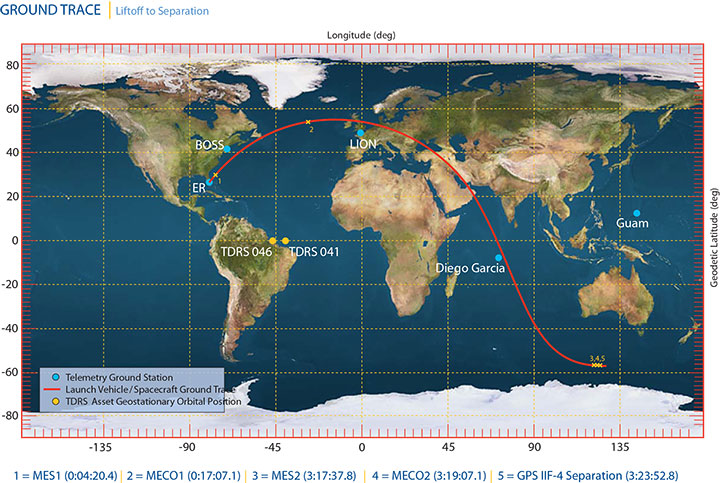
TDRS: Tracking and Data Relay Satellite
MES1: Centaur first main engine start
MECO1: Centaur first main engine cutoff
MES2: Centaur second main engine start
MECO2: Centaur second main engine cutoff
At spacecraft separation, the GPS satellite’s orbit will be circular with a height of 11,047 nautical miles or 20,459 kilometers and an inclination of 55 degrees.