

No audio available for this content.
Q: Why do we need to take integrity seriously in the vehicle environment?

University of New South Wales
A: Since the 1980s, surveyors and geodesists have used GPS for high-accuracy positioning. We take for granted centimeter- and even millimeter-level accuracy positioning capability that is faster, more reliable, at a lower cost and with fewer constraints than ever before. However, the demand for “trustworthy positioning” dismisses such achievements, and the mantra is more “availability” and greater “integrity” to support highly automated driving. Our positioning and navigation community must rise to this challenge.

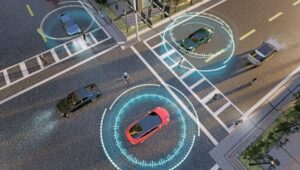
A: In autonomous vehicles, a GNSS/inertial module will be just one of several sensors used for location. The risk of contributing to accidents and serious injury will be decomposed and allocated between subsystems by the OEM or system designer. Taking aviation as a model, the allocation to GNSS may be in the form of an alarm limit of a few meters with integrity risk less than 10-6/hour. However, multipath and obstructed sky make automotive risk far more difficult than aviation. Carrier-phase techniques will come into play and new approaches to protection limit estimation will be needed.

Consultant, Sam Pullen Consulting
A: Advanced sensor fusion techniques now make it possible to achieve very accurate PVT results by combining multiple dissimilar sensors. Once we rely on these capabilities for autonomous driving, the primary threat to safety will come from confluences of rare events that were not observed or foreseen during system development. Design for integrity focuses attention on the identification and mitigation of potentially hazardous anomalies before they happen, not afterward.







William K.
For autonomous vehicles the accuracy requirment is most demanding. If an airplane is off course by ten feet probably it will not be noticable, not even detectable. But if a car is off by ten feet it may be driving on the shoulder or hitting an obstruction, such as a bridge abutment. So the consequences are quite extreme. The package that surveyers use can be that accurate, but they are not using cheap consumer grade systens, are they?
The other challenge is creating the map that contains all of this incredibly accurate position and location data. Aircraft need only high accuracy for landing and takeoff, while cars need that accuracy every inch of the route. So who is going to pay for producing and updating the maps that are that accurate?